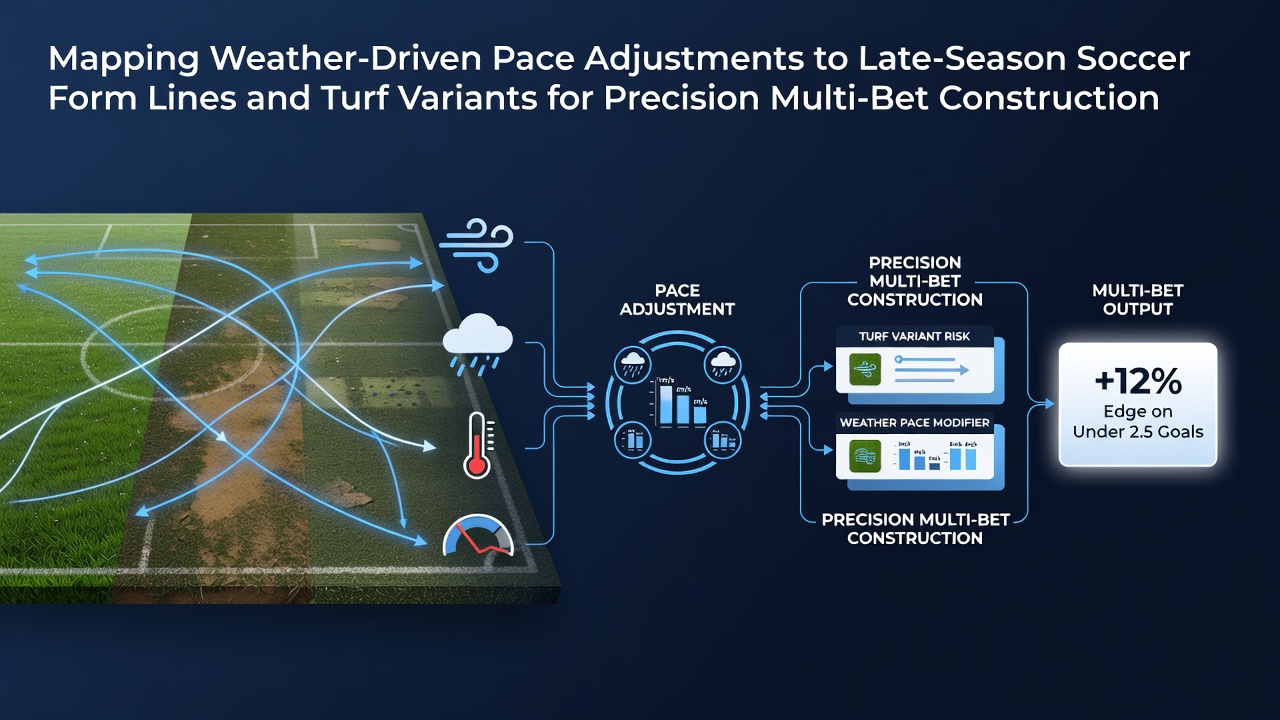
Mapping Weather-Driven Pace Adjustments to Late-Season Soccer Form Lines and Turf Variants for Precision Multi-Bet Construction
Analysts in sports data fields track how weather patterns influence player movement and ball dynamics on pitches across major leagues, particularly as seasons progress into October 2026 when fixture congestion peaks and grass conditions shift noticeably. Teams adjust training regimens based on precipitation forecasts and temperature swings that alter footing, while bettors incorporate these variables into accumulator structures to refine outcome probabilities on multiple legs simultaneously.
Weather Variables and Their Measured Impact on Match Pace
Precipitation levels above 5 millimeters per hour correlate with reduced sprint distances in midfield zones according to tracking data from European competitions, and this reduction often extends to defensive lines where recovery speeds drop by measurable margins. Temperature drops below 8 degrees Celsius slow ball roll on natural surfaces, which forces forwards into tighter passing sequences rather than long diagonals, and such adjustments appear consistently in matches played during transitional autumn periods. Wind speeds exceeding 25 kilometers per hour push long balls off intended trajectories, prompting managers to favor short build-up play that changes expected goal creation patterns tracked by performance platforms.
Integrating Form Lines with Environmental Data
Late-season form lines reflect cumulative fatigue from congested schedules, yet when cross-referenced with historical weather records from similar calendar weeks, these lines reveal repeatable deviations in high-pressing teams whose success rates decline under wet conditions. Observers note that squads with strong home records in dry October fixtures lose that edge when rain coincides with away travel, creating value pockets in over/under markets tied to total distance covered. Researchers at institutions such as the Environment and Climate Change Canada have compiled datasets linking humidity spikes to increased error rates in set-piece execution, data that multi-bet constructors feed into algorithms for selecting correlated legs across several fixtures.
Turf Variants and Their Role in Pace Modulation
Natural grass pitches maintained at lengths between 25 and 30 millimeters allow faster transitions when dry, whereas hybrid surfaces common in newer stadiums retain moisture differently and blunt acceleration bursts after heavy rainfall. Groundskeepers report that aeration schedules in late season alter root density, which in turn affects how quickly water drains and how players plant feet during directional changes. Bettors mapping these variants often separate fixtures by stadium type, grouping those with sand-based root zones separately from soil-heavy pitches because the former show smaller pace reductions in documented rain events.

One study released through the FIFA Technical Department examined pitch samples from multiple continents and found that reinforced turf hybrids maintain consistent friction coefficients even after 10 millimeters of rain, whereas older natural surfaces experience friction spikes that shorten stride length and reduce high-intensity runs by up to 12 percent. These measurements feed directly into models that adjust expected goal tallies and corner counts for accumulator construction, allowing constructors to weight selections toward matches where turf data aligns with favorable weather projections.
Constructing Multi-Bets Through Layered Adjustments
Precision multi-bet construction begins with baseline form metrics drawn from the prior six matches, then applies modifiers for forecast rainfall, wind direction, and pitch variant classifications stored in proprietary databases. Constructors layer these modifiers sequentially so that an initial over-2.5-goals selection on a fast-draining hybrid pitch might receive an upward probability shift when light rain is expected, while the same market on a heavy natural surface receives a downward shift under identical conditions. Data aggregation platforms compile these adjusted probabilities across five or six legs, producing composite odds that reflect the intersection of environmental and performance variables rather than isolated team statistics.
Case Examples from Recent Fixtures
Take a mid-October 2026 match set where two teams with similar expected goal differentials faced contrasting weather and turf conditions: the first on a well-drained hybrid surface under 3 millimeters of rain produced a higher shot volume than historical norms, while the second on a saturated natural pitch saw both teams reduce pressing intensity and finish with fewer than 2.5 total goals. Constructors who mapped these variables in advance placed the outcomes on separate accumulator branches, avoiding correlation traps that arise when identical weather assumptions are applied uniformly across a card.
Conclusion
Mapping weather-driven pace adjustments against late-season form and turf variants supplies a structured framework for refining multi-bet selections with granular environmental inputs. Leagues continue to expand tracking coverage, and meteorological services release increasingly localized forecasts that feed these models, enabling more precise alignment between predicted conditions and actual match dynamics as the 2026 calendar advances.